What is Harbor Pilot? An Intro to SailPoint’s New IAM AI Agent

July 16, 2025
|
Duration:
4
min READ

As identity security becomes more dynamic and complex, SailPoint’s latest innovation, Harbor Pilot, offers a compelling glimpse into the future of intelligent identity management. This agentic AI tool is designed to help teams work more efficiently by generating search queries, building workflows, and accelerating access to insights across SailPoint’s Identity Security Cloud (ISC).

We recently explored Harbor Pilot and gathered some early impressions from one of our IAM experts. Here is what stood out.

Prompting Is Key

Harbor Pilot’s effectiveness depends on the quality of the prompts it receives. Like many AI tools, it performs best when given clear, well-structured input. Learning how to articulate requirements effectively is not only a quick win when using Harbor Pilot, but it is also a valuable long-term skill for engineers and consultants alike.

Where It Adds Value

One of Harbor Pilot’s most helpful features is its ability to generate search queries using pre-built prompts. This is especially useful for admins who may not be familiar with all the searchable fields or syntax within ISC. It lowers the barrier to entry and helps users get to the right information faster.

Another promising area is workflow creation. While the workflows it generates are currently basic, they serve as a great starting point, particularly for those new to SailPoint. It is an excellent way to get comfortable with workflow design and can accelerate onboarding for junior team members.
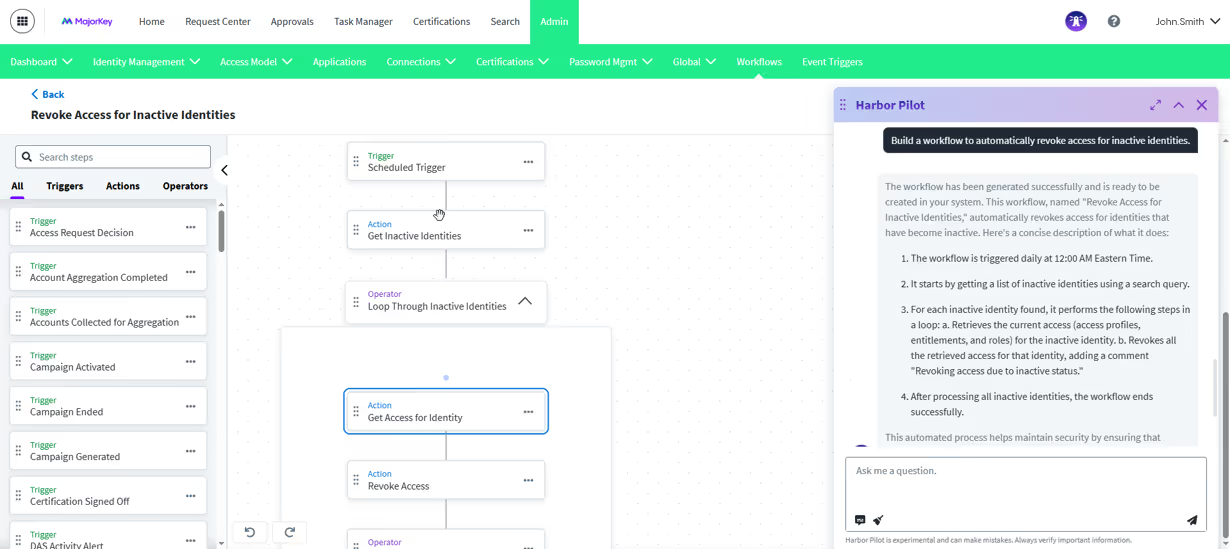
A screenshot of Harbor Pilot, SailPoint's new AI IAM agent.
A view of Harbor Pilot, SailPoint's new AI agent.

Opportunities for Growth

As with any emerging technology, there are areas where Harbor Pilot is still evolving. For example, response times can vary, and the tool may not always reflect the very latest updates from SailPoint’s rapidly advancing platform. These are common challenges for AI systems in fast-moving environments, and we expect continued improvements as the product matures.

One enhancement that could further elevate the experience is the ability to retain context from previous interactions. While Harbor Pilot does not currently have memory across sessions, this is a natural next step that could make it even more intuitive and helpful over time.

A Complement to Existing Resources

Harbor Pilot is not intended to replace core responsibilities or expert judgment. Instead, it serves as a powerful complement, especially for newer users who need help getting unstuck or navigating specific tasks like search and workflow creation. It is also comparable to agentic AI offerings from other major players such as Okta and Microsoft, making it a strong addition to the broader identity ecosystem.

Final Thoughts

Harbor Pilot is a forward-looking tool that reflects SailPoint’s commitment to innovation in identity security. By helping users work smarter and faster, it has the potential to become a valuable collaborative tool  for identity teams. As it continues to evolve, we are excited to see how it can support our work and enhance the way we engage with ISC.

The key takeaway is to stay curious. Explore what Harbor Pilot can do today and keep an eye on what it will do tomorrow.

Authors

Philip Martinez

Director of Information Security
linkedin logo
Connect on LinkedIn

Recent Blogs

Blog

Building a Scalable IAM Application Onboarding Strategy

Building a Scalable IAM Application Onboarding Strategy

A scalable application onboarding strategy helps organizations move faster by treating onboarding as a repeatable business program rather than a one-time technical task.

Blog

Notes from the Field: 5 Challenges Endemic to Copilot Rollouts

Notes from the Field: 5 Challenges Endemic to Copilot Rollouts

Copilot and agentic AI rollouts surface the permissions, labels, access paths, and adoption gaps that already exist in your environment. How do you fix them?

Blog

Understanding LDAP Signing and LDAP Channel Binding Requirements

Understanding LDAP Signing and LDAP Channel Binding Requirements

Active Directory Domain Services relies heavily on LDAP, but not every LDAP connection is automatically protected against interception, modification, or authentication-relay attacks.

Blog

Microsoft Entra ID Retires SMS & Voice Authentication: Why Passkeys Are the New Default

Microsoft Entra ID Retires SMS & Voice Authentication: Why Passkeys Are the New Default

Microsoft Entra ID is sunsetting native SMS and voice MFA to make phishing-resistant passkeys the default.

Blog

Modernizing PAM for the Identity Era: Expanding Beyond Traditional Privileged Accounts

Modernizing PAM for the Identity Era: Expanding Beyond Traditional Privileged Accounts

Learn why modern PAM strategies must extend beyond administrator accounts to include machine identities, cloud entitlements, Just-in-Time access, and Zero Standing Privilege. Dan Ross shares practical guidance for building a scalable privileged access program.

Blog

Make AI Boring

Make AI Boring

As AI becomes more deeply embedded across the enterprise, leaders must focus on the decisions, tradeoffs, and accountability required to scale responsibly.

Blog

What You Need to Know About Microsoft Entra ID’s SSPR Update and How to Mitigate its Operational Risks

Microsoft Entra ID’s SSPR Update and How to Mitigate its Operational Risks

What C-suite leaders need to know about the upcoming Microsoft Entra ID SSPR changes, its operational risks, and how to mitigate them.

Blog

Why IAM Becomes the Critical Path in Application Delivery

Why IAM Becomes the Critical Path in Application Delivery

IAM isn't why most projects start, but it's often why they stall. Learn how proactive identity governance accelerates application delivery.

Blog

TLS Certificates Are Privileged Credentials, CISOs Must Treat Them That Way

TLS Certificates Are Privileged Credentials, CISOs Must Treat Them That Way

Learn why CISOs must treat TLS certificates as machine identities to reduce outages, enforce governance, and strengthen Zero Trust.

Blog

Identity Modernization Is Dead. Long Live AI Readiness!

Identity Modernization Is Dead. Long Live AI Readiness!

AI readiness succeeds when healthcare organizations take an identity-first approach rather than a model-first one.

Blog

Evidence-Based Identity Governance for Streamlined Audits in Healthcare

Evidence-Based Identity Governance for Streamlined Audits in Healthcare

Auditors don’t just ask who has access today. Identity governance needs to be reframed as a continuous regulatory defense, not a periodic compliance exercise.

Blog

The Cost of Waiting: How Access Delays Erode Clinical Efficiency

The Cost of Waiting: How Access Delays Erode Clinical Efficiency

A modern identity strategy ensures access is there when it’s needed, protects clinical operations, and delivers measurable business value without disrupting care.

Blog

Identity Modernization: The Foundation for AI Readiness in Healthcare

Identity Modernization: The Foundation for AI Readiness in Healthcare

In a healthcare setting, AI failures can cause real harm. A strong identity foundation serves as the operational foundation for AI.

Blog

Decentralized Identity Explained: A Practical Q&A for 2026

Decentralized Identity Explained: A Practical Q&A for 2026

Explore the key concepts, benefits, challenges, and emerging trends shaping decentralized identity in 2026 and beyond.

Blog

IGA and Change Management: A Guide to Successful Engagements

IGA and Change Management: A Guide to Successful Engagements

When effective change management is integrated with IGA implementations from the start, organizations reduce resistance, increase alignment, and ensure new identity processes take root in a sustainable, scalable way.

Blog

Outcome‑Driven IAM: Why Identity Programs Win on Results, Not Tools

Outcome‑Driven IAM: Why Identity Programs Win on Results, Not Tools

Why IAM programs fail despite strong tools, and how outcome‑driven IAM delivers measurable risk reduction, audit readiness, and business value.

No items found.
No items found.
No items found.