.svg)

Outcome‑Driven IAM: Why Identity Programs Win on Results, Not Tools

Most IAM programs aren’t failing technically. They're failing because leaders can’t clearly demonstrate the business value IAM delivers.
Executives continue to invest in identity platforms, yet many IAM leaders still struggle to clearly answer a simple question from the business: What value are we actually getting from this?
Too often, the answer comes back in the form of dashboards, features enabled, or projects completed, rather than proof of reduced risk, simplified audits, or faster, safer access.
That disconnect is becoming harder to ignore.
In a recent LinkedIn Pulse article, industry analyst Jay McBain of Omdia highlighted a major shift underway in cybersecurity. Global cybersecurity spend is projected to reach $311 billion, growing 12.1% year over year. But the real story isn’t the size of the market. It’s where the money is going.
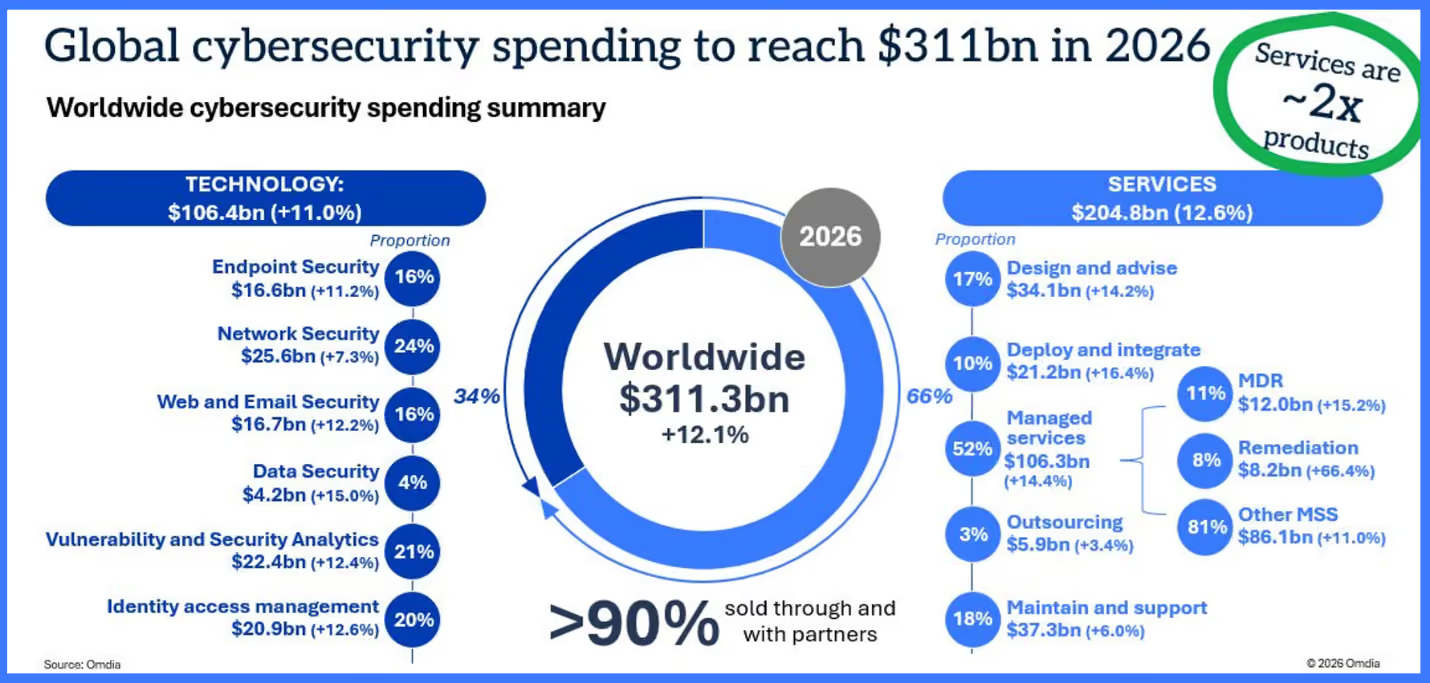
Buyers are moving away from simply purchasing tools and towards buying outcomes. Partner‑led and services‑driven models now account for the majority of cybersecurity delivery, as organizations prioritize continuous risk reduction, compliance confidence, and operational resilience over standalone technology. Identity is explicitly called out as one of the fastest-growing areas in this shift.
That macro trend mirrors exactly what we see every day inside identity and access management (IAM) programs:
IAM isn’t failing because organizations aren’t investing, or because the technology is flawed. The perception of failure stems from poorly defined success criteria, often set by the wrong stakeholders and communicated to the wrong audience. When success is measured without regard to who is impacted and what they need to see, event effective IAM program can appear unsuccessful.
Real progress only becomes visible when outcomes are defined in ways that are meaningful and relevant to every stakeholder involved.
The IAM Problem Beneath the Spend Numbers
Most enterprises today have invested heavily in IAM technologies, including identity governance (IGA), workforce IAM, privileged access management (PAM), authentication, and cloud identity platforms. On paper, the stack looks mature.
Yet IAM leaders are still asked uncomfortable questions:
- Can we prove who has access to what and why?
- Are access controls enforced consistently across systems?
- How quickly can we remove access when roles change or people leave?
- What business value are we actually getting from our IAM investments?
In practice, many organizations see the same warning signs:
- Audit preparation still relies on spreadsheets and manual reconciliation
- Access reviews happen quarterly, but issues surface continuously
- Deprovisioning SLAs exist, yet fail during reorganizations or mergers
- PAM reports exist, but no one fully trusts them during an incident
The gap between IAM capability and IAM performance is where many programs stall. As McBain’s analysis makes clear, buyers aren’t looking for more tools. They want risk reduced, compliance met, and breaches prevented continuously. That expectation is especially true in IAM, where identity now functions as the enablement plane for security, compliance, and digital business.
Why MajorKey Believes IAM Must Be Outcome‑Driven
At MajorKey, we believe IAM success cannot be defined by feature checklists or go‑live milestones. It must be defined by measurable outcomes that both security leadership and the business understand.
This is especially important when success is measured using static metrics, while IAM itself supports highly dynamic activities—users change roles, access needs evolve, and risk conditions shift continuously. When outcomes aren’t aligned to that reality, even well‑implemented IAM programs can appear unsuccessful.
Our perspective is grounded in a simple principle:
Technology creates potential. Outcomes require operationalization.
Deploying an IAM platform may enable controls, but it doesn’t guarantee that those controls are effective, trusted, or sustained. Outcome-driven IAM focuses on what happens after implementation, when identity systems must perform reliably through organizational change, audits, and real-world incidents. It ensures alignment to business goals.
What Is Outcome‑Driven IAM?
Outcome‑driven IAM is an approach that measures identity success by business and security results, not by the number of tools deployed or features enabled.
Instead of asking “Did we enable the feature?”, outcome‑driven IAM asks:
- Did we measurably reduce identity risk?
- Can we prove access is appropriate without manual effort?
- Did audits become simpler and less disruptive?
- Can we ensure “the right access for the right identity to the right resource” in a reliable and predictable way?
- Did we make the business faster and safer at the same time?
The Three Pillars of Outcome-Driven IAM
At MajorKey, outcome‑driven IAM rests on three foundational pillars.
1. Visibility: Proving the State of Identity
You cannot govern identity without visibility.
Outcome‑driven IAM begins with unified visibility across identity systems, including IGA, PAM, directories, cloud platforms, and adjacent systems. Leaders must be able to answer, with confidence:
- Who has access?
- Where is risk concentrated?
- Are controls working as intended?
Visibility is not about collecting more data. It’s about actionable insight that supports decision-making, audit readiness, and timely remediation. Without trusted visibility, identity metrics become noise rather than evidence.
2. Automation: Making Identity Controls Reliable at Scale
Manual IAM processes don’t scale, and they rarely survive organizational change.
Outcome‑driven IAM uses automation to:
- Enforce policy consistently
- Reduce human error
- Eliminate access delays and workarounds
- Keep governance aligned as users, roles, and systems evolve
When careful automation is applied intentionally, IAM shifts from a reactive security function to dependable enterprise infrastructure, where access is provisioned and removed in hours, not weeks, and controls don’t depend on heroics. Careful automation accounts for ensuring optimization without garbage-in-garbage-out.
3. Operations: Keeping IAM Effective After Go‑Live
This is where many IAM programs quietly fail.
Outcome‑driven IAM treats identity as an operating model, not a one‑time project:
- Continuous improvement instead of static configurations
- Ongoing measurement instead of annual fire drills
- Active governance instead of checkbox compliance
Without an operational model, IAM slowly degrades. Roles drift. Exceptions accumulate. Controls that once passed audits lose integrity over time. Sustained outcomes require ownership, measurement, and continuous execution.
What IAM Outcomes Look Like in Practice
For executives, outcomes answer “Why does this matter?”
For IAM teams, outcomes answer “Is this actually working?”
For business owners, outcomes answer “What is in it for me?”
Meaningful IAM outcomes include:
- Audit‑ready identity governance with automated, repeatable reporting
- Reduced identity risk, demonstrated through visibility into privileged access and anomalies
- Faster, safer access enablement without compromising security controls
- Lower operational burden through automation and managed execution
- Improved user experience, where identity enables work instead of increasing friction
In healthcare, this can mean clinicians receiving the right access at the right moment, without delays or unsafe workarounds. In regulated industries, it means proving compliance continuously rather than defensively.
How MajorKey Delivers Outcome‑Driven IAM
MajorKey is built for organizations operating in complex, real‑world identity environments, not greenfield labs.
Our model focuses on moving IAM from vision to value through:
- Advisory Services that align IAM strategy to business KPIs, risk, and compliance objectives, and ensure those strategies are actionable and implemented. Our approach reflects a long‑standing understanding that IAM success is not driven by technology rationalization alone, but by clear outcome alignment across stakeholders.
- Deployment and Integration that go beyond go‑live with automation‑driven execution designed to produce durable outcomes. IAM programs must continuously adapt as business priorities, users, and risks change; progress is rarely static, and identity capabilities must evolve in step with measurable business outcomes.
- Managed Operations (MOps) that extend IAM teams with ongoing governance, optimization, and operational support. Our customers have a business to run; we provide a stable, reliable IAM operating model that allows identity controls to perform consistently without becoming a distraction or bottleneck.
Across all of this, the focus remains the same – measurable outcomes over technical activity.
Reframing IAM Success
Jay McBain’s analysis underscores a broader cybersecurity reality. Organizations are shifting from buying tools to buying outcomes. IAM may be the clearest example of why this shift matters.
When IAM success is measured by outcomes, including reduced risk, governed access, simplified audits, minimized friction, and clear business enablement, identity programs earn executive trust, sustained funding, and long‑term relevance. Identity is now infrastructure. And infrastructure must work consistently, measurably, and continuously.
That’s why the future of IAM isn’t technology‑driven. It’s outcome‑driven.
A Question Every IAM Leader Should Ask
If you had to prove today how your IAM program reduces business risk or enables the organization, could you do it without exporting data or creating a one-off report?
If not, it may be time to rethink how success is defined.
Did You Notice What's Missing?
This article makes no reference to AI, and that is intentional. Identity security is more fundamental than AI. Without strong identity foundations, AI initiatives introduce risk faster than they deliver value. Effective identity security should enable, govern, and strengthen an organization’s AI ambitions, not attempt to catch up to them after the fact.
Frequently Asked Questions About Outcome-Driven IAM
What is outcome‑driven IAM?
Outcome‑driven IAM is an approach that measures identity success by business and security results, such as reduced risk, audit readiness, and operational efficiency, rather than by tools deployed or features enabled.
How is outcome‑driven IAM different from traditional IAM?
Traditional IAM focuses on implementing technology. Outcome‑driven IAM focuses on operationalizing identity through visibility, automation, and ongoing governance so controls work continuously after go‑live.
Why do IAM programs fail even with strong technology?
IAM programs often fail because success is measured by deployment milestones instead of outcomes. Without visibility, automation, and operational ownership, identity controls degrade over time and fail to deliver measurable value.
What outcomes should IAM leaders measure?
IAM leaders should measure outcomes such as:
- Audit readiness and compliance consistency
- Time to provision and deprovision access
- Reduction in identity‑related risk
- Operational efficiency of IAM processes
- Business impact and user experience
Why is IAM becoming more important in cybersecurity?
IAM has become the control plane for modern security, governing access across cloud, SaaS, and hybrid environments. As identity complexity grows, organizations must focus on continuous governance and outcomes rather than static controls.
How does MajorKey support outcome‑driven IAM?
MajorKey delivers outcome‑driven IAM through advisory services, automation‑focused deployment, and managed operations that sustain governance, visibility, and measurable progress over time.
Authors



.svg)