.svg)

From Deepfakes to Fraudulent Employees: Securing Remote Work
Learn how advanced threats exploit remote hiring and why IDProof+ delivers the trust your business needs.
In our first blog, we introduced IDProof+, a rapidly deployable solution developed in collaboration with authID and integrated with Microsoft Entra Verified ID. It addresses critical vulnerabilities in remote identity verification, enabling organizations to confidently verify and maintain trust in remote individuals.
In this second installment, we explore why this issue is so pressing and why organizations can’t afford to ignore it.
The New Reality: A Diverse, Global, Remote Workforce
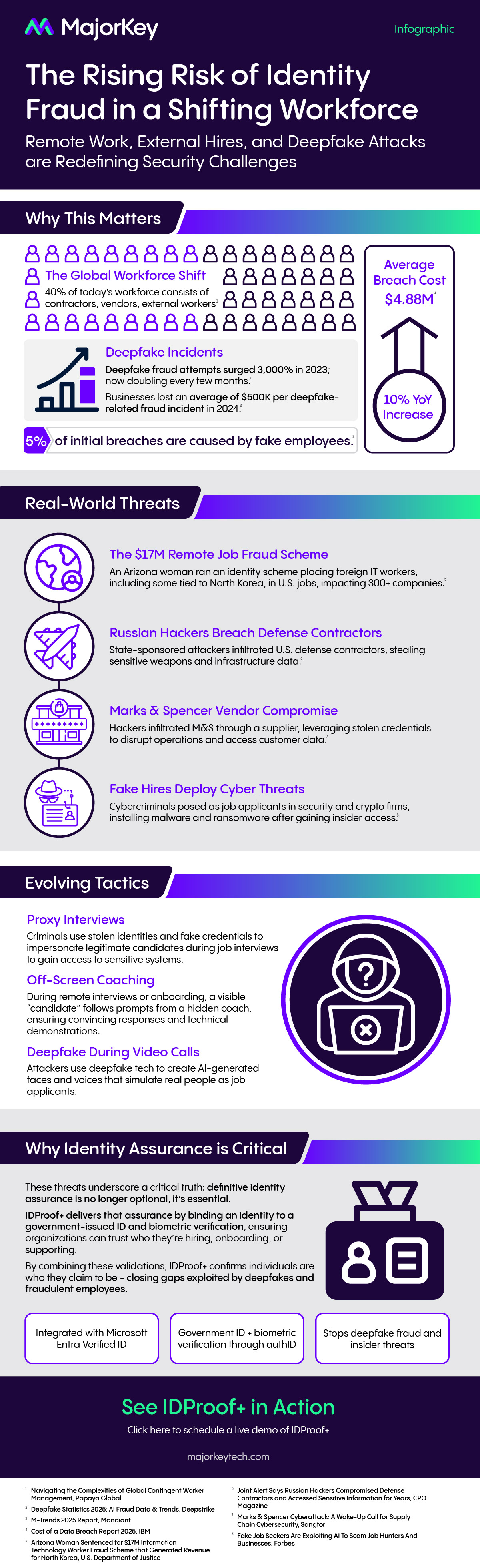
Our global workforce has never been more diverse. Today, contractors, vendors, and external workers make up over 38% of the workforce. Combine that with the rise of remote work and inconsistent onboarding/offboarding processes, and the risks multiply.
Consider these sobering stats:
- Nearly 50% of organizations have experienced a breach involving third-party access, with each breach costing an average of $4.88 million in 2024—a 10% year-over-year increase.1
- According to Google Mandiant's new report, 5% of all initial security breaches weren't caused by hackers, exploits, or malware–they were perpetrated by fraudulent employees secretly working for North Korea. 2
- Deepfake fraud attempts surged 3,000% in 2023; now doubling every few months. 3
- Businesses lost an average of $500K per deepfake-related fraud incident in 2024. 3
Remote work and contractor reliance have created a perfect storm–and hackers know it.
Hackers’ Favorite Targets: Remote Workers and Contractors
The threat isn’t hypothetical–it’s real. Here are a handful of recent real-world examples:
- Arizona Scheme: A woman pleaded guilty to helping funnel North Koreans into more than 300 U.S. companies, sending $17 million overseas. 4
- Defense Contractor Breach: Russian hackers compromised defense contractors and accessed sensitive information for years. 5
- Marks & Spencer Cyberattack: A wake-up call for supply chain cyber security. 6
- Fake applicants are infiltrating cybersecurity and crypto companies, and installing malware and ransomware once hired.
And the tactics keep evolving:
- Proxy Interviews: One person applies, but another shows up.
- Off-screen coaching during video interviews, feeding the applicant answers through an earpiece.
- Deepfakes enabling imposters to appear as legitimate candidates.
Why Identity Assurance is Non-Negotiable
These threats underscore a critical truth: definitive identity assurance is no longer optional—it’s essential. IDProof+ delivers that assurance by binding an identity to a government-issued ID and biometric verification, ensuring organizations can trust who they’re hiring, onboarding, or supporting.
See It In Action
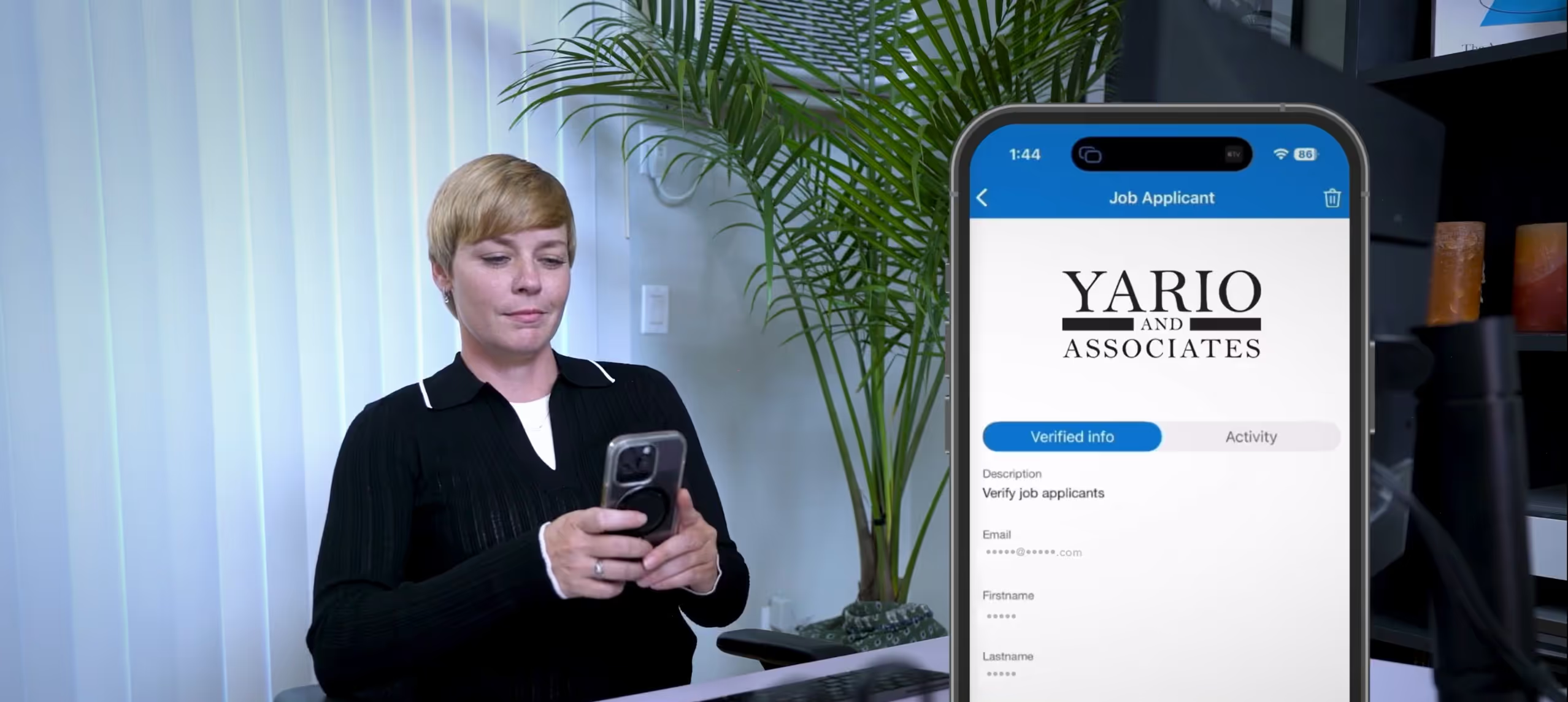
See IDProof+ in action and discover how it stops deepfake fraud and insider threats before they happen.
What’s Next?
In our next and final blog, we’ll dive into three high-risk use cases—remote hiring, contractor onboarding, and help desk callers—and show how IDProof+ verifies users quickly and securely in each scenario.
Ready for a tailored walkthrough for your organization? Book your personalized demo today.
Frequently Asked Questions
Why is identity assurance critical for remote work?
Remote work and contractor reliance have created new vulnerabilities. Nearly 50% of organizations have experienced breaches involving third-party access, costing an average of $4.88 million per breach. Fraudulent employees and deepfake tactics make identity verification essential.
What is IDProof+?
IDProof+ is a rapidly deployable identity assurance solution developed in collaboration with authID and integrated with Microsoft Entra Verified ID. It binds an identity to a government-issued ID and biometric verification, ensuring organizations can trust who they hire, onboard, or support remotely.
What risks do organizations face with remote hiring?
- Fake applicants infiltrating companies and installing malware/ransomware
- Proxy interviews (one person applies, another shows up)
- Off-screen coaching during video interviews
- Deepfakes used to impersonate legitimate candidates
Is the threat of interview fraud real or hypothetical?
It is very real. Examples include:
- Arizona Scheme: $17M funneled overseas via fake hires
- Defense Contractor Breach: Russian hackers accessed sensitive data
- Marks & Spencer Cyberattack: Supply chain vulnerability exposed
How does IDProof+ prevent interview fraud and fake job candidates?
By combining government ID validation and biometric verification, IDProof+ ensures the person you’re hiring or onboarding is who they claim to be—closing gaps exploited by deepfakes and fraudulent employees.
Who needs IDProof+?
Any organization with:
- Remote workers
- Contractors or vendors
- External workforce onboarding
- Sensitive data or compliance requirements
How can I see IDProof+ in action?
You can book a personalized demo to see how IDProof+ stops deepfake fraud and insider threats before they happen.
1 https://www.ibm.com/reports/data-breach
2 https://cloud.google.com/security/resources/m-trends
3 https://deepstrike.io/blog/deepfake-statistics-2025
6 https://www.sangfor.com/blog/cybersecurity/marks-spencer-cyberattack-2025-supply-chain-breach

.svg)